How Much Do New Gutters Cost in Connecticut?
October 1, 2026
Most Connecticut homeowners pay about $2,000 to $5,500 for new seamless aluminum gutters and downspouts, including removal of the old system. That works out to roughly $8 to $15 per linear foot installed for standard aluminum, with a typical Connecticut home needing about 150 to 250 linear feet. Six-inch gutters, two- and three-story homes, complex rooflines, gutter guards, and fascia repairs push the price higher. Copper and other premium materials can cost several times more.
Artisan Building & Remodeling has been installing roofs, siding, and seamless gutters across Connecticut since 2017, working out of offices in Berlin and Westbrook. We are a GAF Master Elite contractor, a status held by only about 2 percent of roofers in North America, and we are licensed under Connecticut HIC-0651418 with more than 400 verified reviews. Gutters are part of our everyday work, and this guide explains what drives the price on a Connecticut home.
In This Guide
- Gutter Cost at a Glance: Typical price ranges by material.
- How Gutters Are Priced: Linear feet and what they include.
- What Raises or Lowers the Price: The factors behind your quote.
- Gutter Sizes and Downspouts: How capacity affects cost.
- Gutter Guards: Worth the Extra Cost?: When they pay off.
- Copper and Premium Gutters: What drives the higher price.
- Timing Your Gutter Replacement: When to schedule.
- Hidden Costs to Plan For: What an estimate may leave out.
- Replacing Gutters With a New Roof: Timing that saves money.
- How to Compare Gutter Quotes: Questions to ask.
- Frequently Asked Questions: Quick answers.

Gutter Cost at a Glance
The table below shows typical installed prices for the gutter materials Connecticut homeowners ask about most. These are planning ranges. Your quote depends on your home.
| Gutter Material | Installed Cost per Linear Foot | Typical Connecticut Home (150 to 250 ft) |
|---|---|---|
| Seamless aluminum, 5-inch | About $8 to $12 | About $1,500 to $3,000 |
| Seamless aluminum, 6-inch | About $10 to $15 | About $2,000 to $3,800 |
| Galvanized or coated steel | About $10 to $20 | About $2,000 to $5,000 |
| Copper, seamless or half-round | About $30 to $50 | About $5,000 to $12,000 or more |
| Vinyl sectional | About $4 to $8 | Rarely recommended for Connecticut homes |
Downspouts, removal of old gutters, and any fascia repair are often priced separately, which is how many full replacements land in the $2,000 to $5,500 range.
How Gutters Are Priced
Gutter contractors price almost everything by the linear foot, but a good estimate breaks that number down so you can see what you are paying for.
What the Linear Foot Price Usually Covers
For seamless aluminum, the per-foot price typically includes forming the gutter on site from a coil, cutting it to the exact length of each roof edge, hangers, end caps, outlets, and sealing at corners. Because the gutter is formed to length, the only seams are at corners and outlets. That is the main reason seamless aluminum is the standard choice for Connecticut homes.
What Is Often Priced Separately
Downspouts are usually priced per foot or per unit. Removal and disposal of the old system, fascia or soffit repair, gutter guards, and underground drain connections are typically separate line items. When you compare quotes, check whether each one includes these.
Seamless vs. Sectional
Sectional gutters come in pre-cut lengths that are joined together, so every joint is a potential leak point. They cost less upfront and are common in big-box store kits. Seamless gutters are formed on site to the full length of each roof edge, which leaves far fewer joints to fail. On Connecticut homes, where freeze-thaw cycles work on every seam, the small price difference usually favors seamless.
What Raises or Lowers the Price
Two homes on the same street can get very different quotes. These factors make the difference:
- Total linear feet. A long ranch in Berlin may need more gutter than a compact two-story colonial.
- Height of the house. Two- and three-story homes need more ladder work and safety setup, which adds labor.
- Roofline complexity. Every inside and outside corner, dormer, and short run adds time and material.
- Gutter size. Six-inch gutters and larger downspouts cost more than standard 5-inch systems.
- Material and thickness. Heavier-gauge aluminum, steel, and copper cost more than standard aluminum.
- Color. Standard colors are usually included. Custom or specialty finishes may add cost.
- Condition of the fascia. Rotted boards must be repaired before new gutters can be hung securely.
- Access. Landscaping, decks, steep grades, and tight lot lines can slow the work.
Why Connecticut Homes Cost More Than National Averages
Many national cost guides assume a single-story house with a simple roof. Connecticut's housing stock includes a lot of two-story colonials, capes with dormers, and older homes with complex rooflines. Add higher labor costs than much of the country and the snow and ice our gutters have to handle, and local prices tend to sit above the national averages you will see online.
Gutter Sizes and Downspouts
Size is one of the biggest choices that affects both cost and performance.
5-Inch vs. 6-Inch Gutters
Standard 5-inch K-style gutters work for many homes. Six-inch gutters hold roughly 40 percent more water and are worth the upgrade on large roofs, steep roofs, long runs, and roof valleys that dump heavy flow into one spot. They cost more per foot, but undersized gutters that overflow every heavy storm end up costing more in the long run. Our guide to 5-inch vs. 6-inch gutters explains how to choose.
Downspouts Matter as Much as Gutters
A gutter can only drain as fast as its downspouts. Larger 3-by-4-inch downspouts move far more water than standard 2-by-3-inch ones and are less likely to clog with leaves. Adding a downspout in the right place is often cheaper than upsizing an entire gutter run.
Gutter Guards: Worth the Extra Cost?
Gutter guards typically add about $7 to $20 per linear foot installed, depending on the type. On a Connecticut home surrounded by oaks, maples, or pines, a good micro-mesh guard can cut down dramatically on cleaning and clogging.
When Guards Make Sense
Guards pay off most on homes with heavy tree cover, two-story roofs that are dangerous to clean, and homes where clogged gutters have already caused overflow or basement water. On a home with few trees, the extra cost may not be worth it.
What to Know About Winter
Guards do not prevent ice dams, which form on the roof itself because of heat loss from the house. They also need occasional cleaning of the surface. Learn more about our
gutter guard options or read about
how gutter guards save time and money.
Copper gutters are the high-end choice, most often seen on historic homes, stone and brick houses, and custom builds along the shoreline and in towns like Glastonbury, Farmington, and Madison. They can last for many decades and develop a natural patina over time.
What Drives the Higher Price
Copper costs far more per foot as a material, and it takes more skilled labor to form, solder, and install. Half-round profiles, which suit older architecture, add cost compared with standard K-style. Copper downspouts, decorative leader heads, and custom brackets add more.
Is Copper Worth It?
For a historic or high-end home where appearance and longevity matter, it can be. For most homes, painted seamless aluminum gives excellent performance at a fraction of the cost, and color choice does more for curb appeal than material. Our guide to the
best gutter colors covers how to match gutters to your roof, siding, and trim.
Timing Your Gutter Replacement
Late summer and fall are the busiest times for gutter work in Connecticut, as homeowners try to get ahead of leaf season and winter. Scheduling in spring or early summer often means shorter wait times. If your gutters are sagging or pulling away, though, do not wait. Loaded with snow and ice, a failing gutter can tear off the fascia and cause far more expensive damage. Winter installs are possible on dry days, but sealants cure more slowly in the cold, so most crews prefer temperatures above freezing for the best results.
Some costs only become clear once the old gutters come down.
Fascia and Soffit Damage
Years of overflowing gutters often rot the fascia boards behind them. Rotted fascia has to be replaced before new gutters can be hung, and it is one of the most common add-ons we see on older Connecticut homes. Ask for a per-foot price for fascia replacement in writing.
Drainage at the Ground
Gutters only move water to the downspouts. If downspouts dump water against the foundation, you may still get basement moisture. Extensions, splash blocks, or connections to underground drains may be worth adding.
Removal and Disposal
Removing old gutters, especially heavy steel or multiple layers of patched sections, takes time. Most contractors include this in a replacement quote, but confirm it.
Permits and Historic Districts
Gutter replacement does not usually require a building permit in Connecticut, but homes in local historic districts in towns like Wethersfield, Litchfield, and Guilford may need approval for visible exterior changes, including gutter profile or material. If your home is in a historic district, check with your town before choosing a new style. It can affect both the product you are allowed to use and the timeline.
Replacing Gutters With a New Roof
If your roof is near the end of its life, it often makes sense to replace the gutters at the same time. The crew already has access to the roof edge, drip edge can be installed correctly behind the new gutters, and you avoid damaging new gutters with a later tear-off. Aluminum gutters often last 20 years or more, so if your gutters and roof are of similar age, doing both together can save labor and hassle. Our guide on how long new gutters last and the signs your gutters need to be replaced can help you decide.
How to Compare Gutter Quotes
Gutter quotes can vary by thousands of dollars. Before you compare the bottom line, make sure each one answers these questions:
- How many linear feet of gutter and downspout are included?
- Is it 5-inch or 6-inch, and what is the aluminum thickness?
- What type of hangers are used, and how far apart are they spaced?
- Is removal of the old system included?
- What is the price for any fascia repair needed?
- Are gutter guards included or optional?
- What warranty covers the workmanship?
Hanger spacing is a detail worth asking about in Connecticut. Snow and ice add serious weight, and gutters with too few hangers are more likely to sag or pull away after a hard winter.
Get a Gutter Estimate From Artisan Building & Remodeling
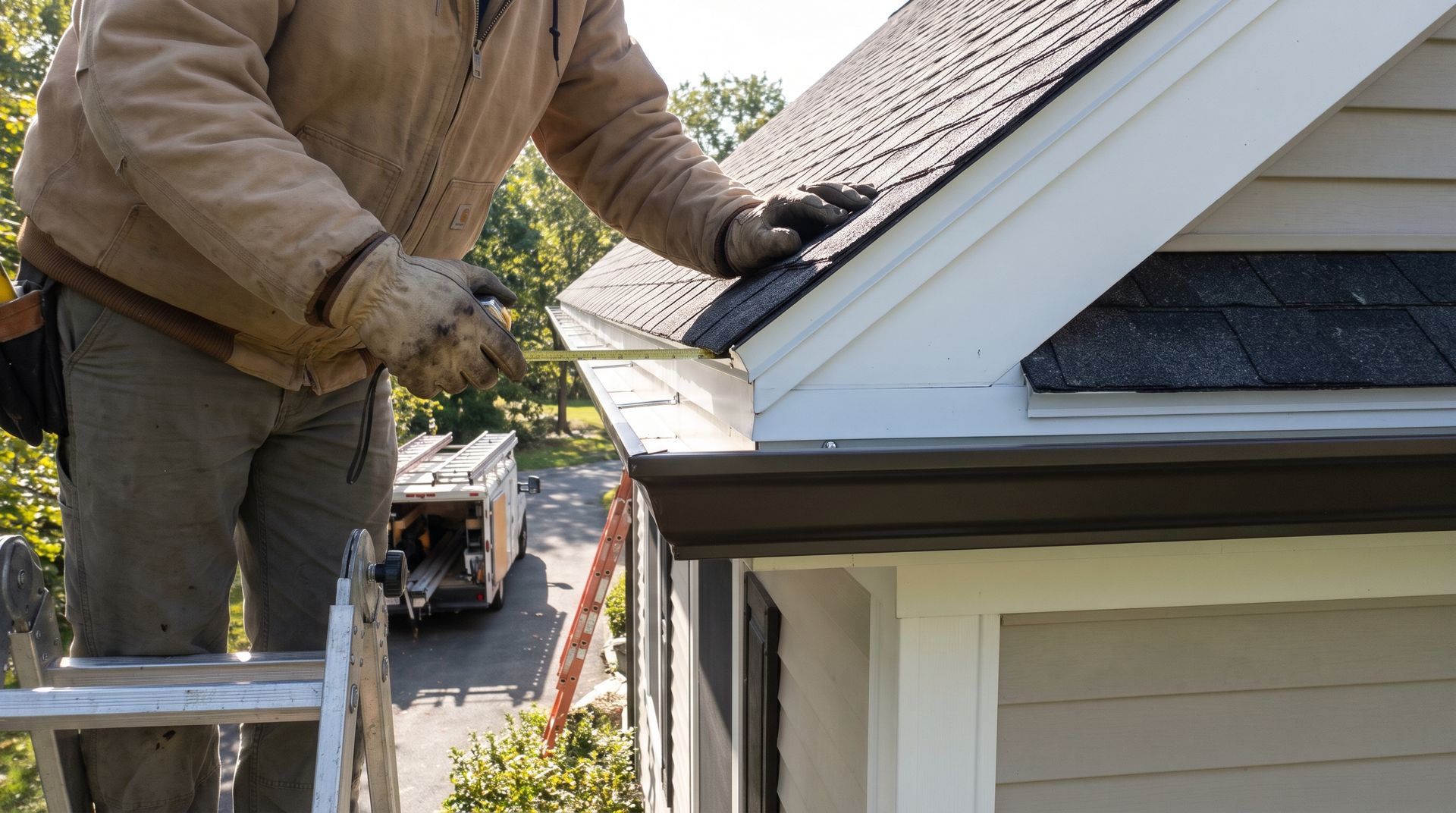
The only way to know exactly what your gutters will cost is to have the roofline measured and the fascia checked. Our team will measure your home, recommend the right size and downspout layout, and give you a clear written estimate. Learn more about our gutter installation and repair services, see finished projects in our gallery, or check our financing options.
Call Artisan Building & Remodeling at (860) 759-8617 or
contact us for a free estimate. If you live near our main office, see our breakdown of
gutter costs in Berlin.
Frequently Asked Questions
How much do new gutters cost in Connecticut?
Most Connecticut homeowners pay about $2,000 to $5,500 for new seamless aluminum gutters and downspouts, including removal of the old system. Standard aluminum usually runs about $8 to $15 per linear foot installed. Copper, larger homes, and gutter guards cost more.
How many linear feet of gutters does a house need?
Many Connecticut homes need about 150 to 250 linear feet of gutter, depending on the size and shape of the roof. A contractor measures each roof edge where water runs off to get the exact number.
Are 6-inch gutters worth the extra cost?
For large or steep roofs, long runs, and areas where roof valleys concentrate water, yes. Six-inch gutters hold significantly more water than 5-inch gutters and are less likely to overflow during heavy rain. For smaller, simpler roofs, 5-inch gutters are often enough.
How long do aluminum gutters last in Connecticut?
Seamless aluminum gutters often last 20 years or more with proper installation and maintenance. Good hanger spacing, correct pitch, and regular cleaning help them hold up to Connecticut snow and ice.
Should I replace my gutters when I replace my roof?
It often makes sense if the gutters are older or damaged. Replacing both at once allows proper drip edge installation, avoids damage to new gutters during a later roof tear-off, and can reduce total labor costs.
Share this Post
Recent Blog Post