5-Inch vs. 6-Inch Gutters: Which Size Does Your Home Need?
October 28, 2026
Most average-sized Connecticut homes with moderate roof pitches do fine with 5-inch gutters. Choose 6-inch gutters if your roof is large, steep, or has long runs, if roof valleys dump heavy water into one section, or if your current gutters overflow during heavy rain even when they are clean. A 6-inch K-style gutter holds roughly 40 percent more water than a 5-inch gutter, and it pairs with larger downspouts that clog less. The upgrade usually adds a modest amount per linear foot, which is often cheaper than the water damage caused by overflowing gutters.
Artisan Building & Remodeling has installed roofs, siding, and seamless gutters on Connecticut homes since 2017, from our offices in Berlin and Westbrook. We are a GAF Master Elite roofing contractor, licensed under Connecticut HIC-0651418, with more than 400 verified reviews. We size gutters on every roof we replace, and this guide explains how we decide between 5-inch and 6-inch.
In This Guide
- The Quick Comparison: Side-by-side differences.
- What "5-Inch" and "6-Inch" Actually Mean: How gutters are measured.
- When 5-Inch Gutters Are Enough: Homes that do not need the upgrade.
- When You Need 6-Inch Gutters: Signs you need more capacity.
- Signs Your Current Gutters Are Undersized: What overflow tells you.
- How Contractors Size Gutters: Roof area, pitch, and rainfall.
- Downspouts: The Other Half of the Equation: Why they matter as much.
- Cost Difference Between 5-Inch and 6-Inch: What the upgrade costs.
- Installation Matters as Much as Size: Pitch, hangers, and fascia.
- Connecticut Weather and Gutter Size: Snow, ice, and heavy storms.
- Frequently Asked Questions: Quick answers.
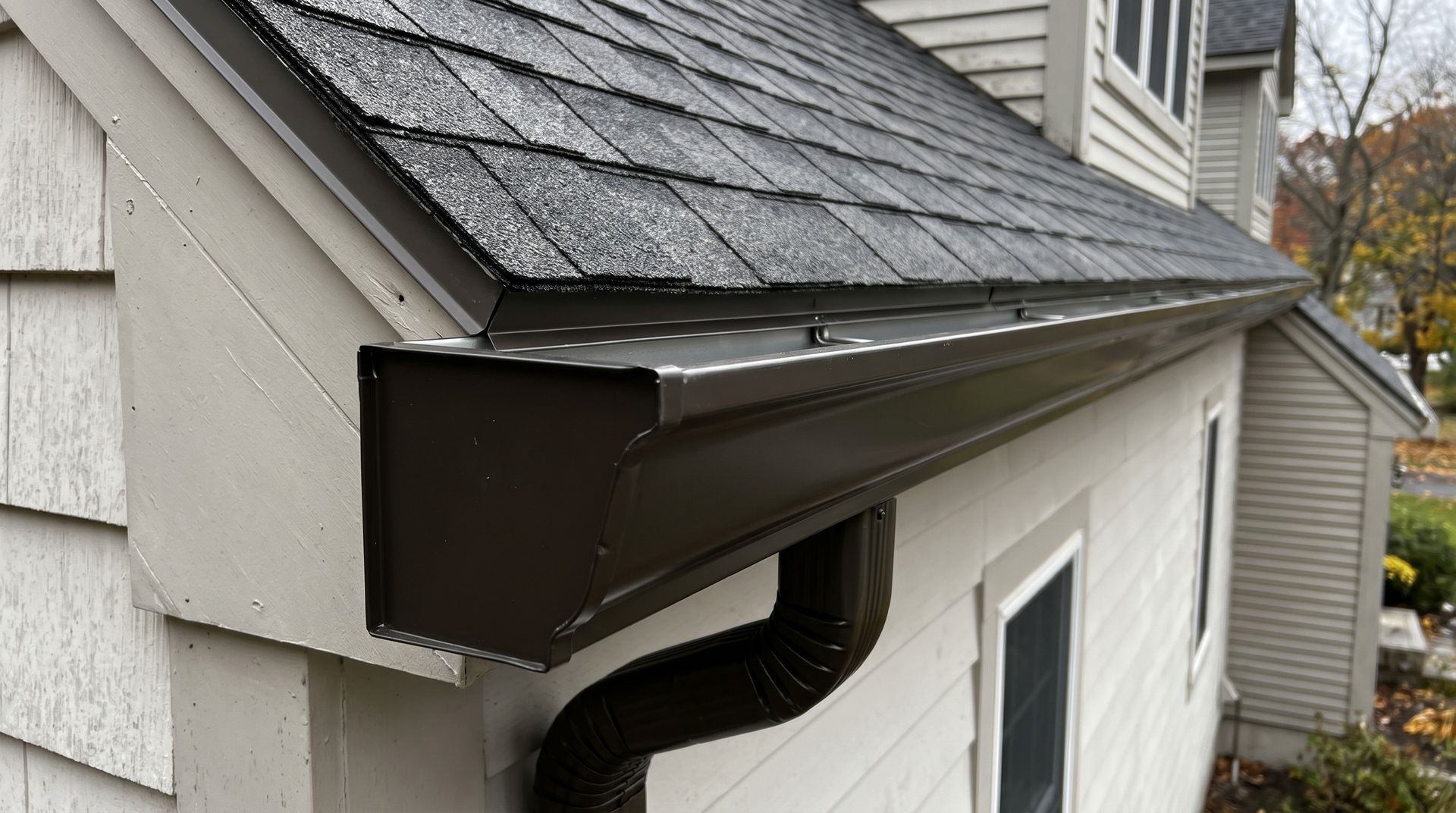
The Quick Comparison
Here is how the two most common residential gutter sizes stack up.
| Feature | 5-Inch K-Style | 6-Inch K-Style |
|---|---|---|
| Water capacity | About 1.2 gallons per foot | About 2 gallons per foot |
| Typical downspout | 2 x 3 inches | 3 x 4 inches |
| Best for | Average roofs with moderate pitch | Large, steep, or complex roofs |
| Clog resistance | Good with regular cleaning | Better, especially at downspouts |
| Appearance | Standard look on most homes | Slightly larger profile at the roof edge |
| Relative cost | Lower | Moderately higher per foot |
For many homes, either size works. The decision comes down to how much water your roof sends to each gutter run.
What "5-Inch" and "6-Inch" Actually Mean
Gutter size refers to the width across the top opening of the gutter, not its depth. A 6-inch gutter is wider and deeper than a 5-inch gutter, which is why it holds so much more water even though the number only changes by one.
K-Style vs. Half-Round
Most Connecticut homes have K-style gutters, which have a flat back and a decorative front that looks like crown molding. Half-round gutters are rounder and hold less water at the same width, so a 6-inch half-round has less capacity than a 6-inch K-style. Half-round is common on historic homes and with copper systems. If you are choosing half-round, sizing up becomes even more important.
Gauge Is a Separate Choice
Size and thickness are different things. Aluminum gutters commonly come in thicknesses like .027 and .032 inches. Thicker material resists dents from ladders and ice. Many contractors pair 6-inch gutters with heavier-gauge aluminum for added strength.
When 5-Inch Gutters Are Enough
Five-inch gutters remain the standard for a reason. They work well on:
- Average-sized homes with simple rooflines and moderate slopes.
- Single-story ranches and capes where water flows over short, even runs.
- Homes with well-placed downspouts that keep each run short.
- Roofs without large valleys concentrating water into one spot.
- Homes with a history of no overflow when the gutters are clean.
If your current 5-inch gutters have handled heavy storms without spilling over, and you are not changing the roof, there is usually no need to upsize.
When You Need 6-Inch Gutters
The upgrade pays off when a 5-inch gutter simply cannot keep up. Watch for these situations:
- Overflow during heavy rain, even when the gutters are clean and properly pitched.
- Large roof sections draining into a single gutter run.
- Steep roofs, where water hits the gutter fast enough to shoot over the front edge.
- Roof valleys that dump water from two slopes into one corner.
- Long runs of 40 feet or more between downspouts.
- Metal roofs, which shed water and snow faster than shingles.
- Heavy tree cover, where larger gutters and downspouts clog less often.
The Valley Problem
One of the most common issues we see is overflow at a single corner where a roof valley meets the gutter. The rest of the gutter may be fine. In those cases, the fix may be a 6-inch section, an extra downspout, or a diverter rather than upsizing the whole house. That is why sizing should be done run by run, not as a single choice for the entire roof.
Signs Your Current Gutters Are Undersized
You do not need to wait for a roof replacement to find out whether your gutters are too small. These signs usually show up during or after a heavy storm:
- Water sheeting over the front edge of the gutter while it is raining hard.
- Splash marks or eroded mulch in a line below the gutter.
- Staining or peeling paint on the fascia and trim behind the gutter.
- Wet basement walls on the same side of the house after storms.
- Overflow at inside corners where two roof slopes meet.
- Downspouts that gush at the top instead of carrying all the water down.
Before assuming the gutter is too small, rule out the simple causes. Clogs, sagging sections, and gutters pitched the wrong way all cause overflow on correctly sized systems. If the gutters are clean, straight, and still spilling over, capacity is the likely problem.
How Contractors Size Gutters
Proper gutter sizing is based on math, not guesswork.
Roof Area
The starting point is the square footage of roof draining into each gutter run. A large, uninterrupted slope sends much more water to its gutter than a small section over a porch.
Roof Pitch
Steeper roofs catch more wind-driven rain and send water down faster. Sizing methods use a pitch factor that increases the effective roof area for steeper slopes, which is why a steep colonial may need 6-inch gutters while a low-pitch ranch of similar size does not.
Rainfall Intensity
Gutters are sized for the heaviest short bursts of rain, not average rainfall. Connecticut regularly sees intense summer thunderstorms and remnants of tropical systems that dump a lot of water in a short time. A system sized only for average rain will overflow in exactly the storms that matter most.
Downspouts: The Other Half of the Equation
A gutter can only drain as fast as its downspouts allow. Even a 6-inch gutter will overflow if it empties into a small, clogged downspout.
2 x 3 vs. 3 x 4 Downspouts
Standard 2-by-3-inch downspouts are common on 5-inch systems. Larger 3-by-4-inch downspouts are typical with 6-inch gutters and can move roughly twice as much water. They are also much less likely to clog with leaves, pine needles, and seed pods.
Placement Matters
Adding a downspout to shorten a long run can solve overflow without upsizing the gutter. Good contractors look at where water collects, not just at the length of the roof edge. Our
gutter installation and repair
team sizes downspouts to the roof area they serve.
Cost Difference Between 5-Inch and 6-Inch
Six-inch gutters cost more because they use more material and pair with larger downspouts. The difference is often a few dollars per linear foot installed. On a typical Connecticut home with 150 to 250 feet of gutter, that can add a few hundred dollars or more to the project. For a full breakdown, see our guide to how much new gutters cost in Connecticut.
When the Upgrade Pays for Itself
Overflowing gutters dump water along the foundation, soak fascia boards, and can lead to basement leaks and rot. If your home is prone to any of these, the extra cost of 6-inch gutters is small compared with the repairs it helps prevent.

Installation Matters as Much as Size
A perfectly sized gutter will still fail if it is installed poorly.
Pitch
Gutters need a slight slope toward each downspout so water keeps moving. Too little pitch lets water sit and freeze. Too much makes the gutter look crooked and can cause water to overshoot the downspout. Getting it right is one of the main reasons seamless gutters are formed and hung by experienced crews rather than pieced together.
Hangers and Fascia
Hangers hold the gutter to the house and carry its weight when it is full of water, snow, or ice. In Connecticut, closer hanger spacing is worth the small added cost, especially for 6-inch gutters. The fascia board they attach to has to be solid. Hanging new gutters on rotted fascia is a common shortcut that leads to sagging within a few seasons.
Connecticut Weather and Gutter Size
Connecticut gutters have to handle more than rain.
Snow and Ice
Larger gutters hold more snow and ice, which adds weight. That makes hanger spacing and fascia condition just as important as gutter size. A 6-inch gutter should be hung with sturdy hangers placed close together so it can carry a winter load without sagging.
Ice Dams
Gutter size does not prevent ice dams. Ice dams form on the roof when heat from the house melts snow that refreezes at the colder roof edge. Bigger gutters will not fix that, but proper attic insulation and ventilation will. Our guide to ice dam causes and fixes in Connecticut explains more about how winter water behaves at the roof edge.
Fall Leaves
Many Connecticut neighborhoods are heavily wooded, and fall leaves fill gutters quickly. Wider gutters and larger downspouts clog less often, and pairing them with gutter guards can reduce cleaning even further.
Metal Roofs Shed Faster
Metal roofing is becoming more common on Connecticut homes, and it changes gutter sizing. Water and snow slide off metal much faster than off shingles, so gutters under a metal roof take heavier bursts of flow. Snow guards on the roof above can help protect the gutters from sliding snow, and 6-inch gutters with sturdy hangers are often the better match.
Choosing the Right Size With a New Roof
A roof replacement is the ideal time to reconsider gutter size. The crew can install drip edge correctly behind the new gutters, and if you are switching to a steeper or larger roof section, or to metal roofing, the sizing needs may change. Our guides on
how long new gutters last and
the signs your gutters need to be replaced can help you decide whether to replace them together.
Get the Right Gutter Size for Your Home
If you are unsure whether your home needs 5-inch or 6-inch gutters, our team can measure your roof, look at the trouble spots, and recommend a size and downspout layout that fits how water actually moves off your house. See completed projects in our gallery or learn about our financing options.
Call Artisan Building & Remodeling at (860) 759-8617 or
contact us for a free estimate anywhere we serve in Connecticut.
Frequently Asked Questions
Are 6-inch gutters better than 5-inch gutters?
Not always. Six-inch gutters hold more water and clog less, which makes them better for large, steep, or complex roofs. For average homes with moderate roof pitches, 5-inch gutters usually handle the water just fine at a lower cost.
How much more water does a 6-inch gutter hold?
A 6-inch K-style gutter holds roughly 40 percent more water than a 5-inch K-style gutter, or about 2 gallons per foot compared with about 1.2 gallons. It is also usually paired with larger downspouts that drain faster.
Can I mix 5-inch and 6-inch gutters on the same house?
Yes. Many homes use 6-inch gutters only on the sections that handle the most water, such as below large slopes or roof valleys, and 5-inch gutters elsewhere. A contractor can size each run based on the roof area it serves.
Do 6-inch gutters look too big on a house?
On most homes, the difference is hard to notice from the ground. The slightly larger profile can look out of scale on small homes or low rooflines, but it usually blends in on two-story homes and larger roofs, especially when the color matches the trim.
Do bigger gutters help with ice dams?
No. Ice dams form on the roof because of heat escaping from the house, not because of gutter size. Proper attic insulation and ventilation are what prevent them. Larger gutters do hold more snow and ice, so good hanger spacing is important.
Share this Post
Recent Blog Post