TimberTech vs. Trex Decking: Which One Is Better for Your CT Home?
August 26, 2026
The single most useful thing to know before you compare TimberTech and Trex is that they are not the same product in two boxes. Trex builds capped composite decking only. TimberTech builds both capped composite and a capped PVC line called AZEK, which contains no wood at all. That one difference drives most of the decisions below, because a PVC board behaves differently in heat and moisture than a wood-composite one. Beyond that, Trex tends to win on price and sheer availability, while TimberTech is often praised for the most realistic wood-grain look and its cooler, moisture-proof PVC option.
At Artisan Building and Remodeling, we design and build decks across Connecticut and install both brands, so we have no stake in steering you toward one. We have served homeowners here since 2017 as a licensed Connecticut contractor (HIC #0651418) with an A+ Better Business Bureau rating, and the comparison below reflects how these boards actually behave through our winters and summers.
In This Guide
- Are TimberTech and Trex the Same Company?: The quick answer that changes the comparison.
- The Real Difference: Product Lines: Each brand's tiers, from budget to premium.
- Cost Comparison for CT Homeowners: Real price ranges by tier.
- Durability and Heat in Connecticut: How each handles snow, moisture, and summer sun.
- Appearance and Style: Realism, color, and texture.
- Warranties and Transferability: What is covered and whether it passes to a buyer.
- Which Brand Should You Choose?: Matching the brand to your deck.
- Frequently Asked Questions: Answers to common decking questions.
Are TimberTech and Trex the Same Company?
No, and this trips up a lot of homeowners. Trex is made by Trex Company, an independent manufacturer that helped create the composite category. TimberTech is a brand owned by The AZEK Company, a separate business that also makes the AZEK PVC boards you may have seen.
That corporate split matters because it explains the product ranges. Trex focuses entirely on capped composite, so every Trex board has a recycled wood-and-plastic core wrapped in a protective shell. TimberTech spans both capped composite and capped PVC, which gives it a moisture-proof option Trex simply does not offer. If a salvage-proof, near-waterproof board is your priority, that alone can decide the brand for you.
The Real Difference: Product Lines
Comparing "TimberTech versus Trex" as single products is misleading, because each brand sells a ladder of collections from entry-level to flagship. The fair comparison is tier against tier, and knowing the names helps you read a quote or a showroom display accurately.
Trex's Lineup
Trex organizes its decking into three broad tiers, all capped composite. Each step up adds richer coloring, better scratch and fade performance, and a higher price.
- Trex Enhance is the entry tier, offering solid and lightly streaked boards at the most competitive price.
- Trex Select sits in the middle with more color depth and a slightly more premium feel.
- Trex Transcend is the flagship, with the deepest wood-tone realism, and its Lineage boards are engineered to stay cooler underfoot.
TimberTech's Lineup
TimberTech splits into a composite family and a PVC family, which is the crucial distinction. The composite lines compete with Trex directly, while the PVC line has no Trex equivalent.
- TimberTech EDGE is the entry composite tier, comparable in price and purpose to Trex Enhance.
- TimberTech PRO is the premium composite line, with strong grain realism and durability.
- TimberTech AZEK is the capped PVC line, containing no wood, and it leads the market on moisture resistance and a cooler surface.
Put simply, if you are shopping the budget end, you are choosing between Trex Enhance and TimberTech EDGE. If you want the best moisture and heat performance, TimberTech AZEK is the board Trex cannot match with a composite product, and it is the reason many poolside and shaded decks in Connecticut end up as TimberTech rather than Trex.
Cost Comparison for CT Homeowners
Both brands span a wide price range, so a blanket "TimberTech is more expensive" misses the point. The truer statement is that at the budget end the two are close, and at the premium end TimberTech's PVC line usually costs the most. Treat the figures below as ballpark material ranges, since deck size, height, railing, and site conditions drive the installed total far more than the board alone.
| Tier | Trex | TimberTech | Typical Board Cost |
|---|---|---|---|
| Entry composite | Enhance | EDGE | Lower range, Trex often edges lower |
| Premium composite | Transcend | PRO | Mid to upper range, closely matched |
| PVC (moisture-proof) | Not offered | AZEK | Highest range |
What Drives the Installed Price
The board is only part of the number. On a finished deck, the substructure, footings, stairs, and railing often account for as much as the decking itself, which is why two quotes for the "same" board can differ widely.
Railing choice is a frequent surprise. Both brands sell coordinating railing systems, and stepping up to a premium aluminum or composite rail can add meaningfully to the total. Financing helps spread that out, and Artisan Building and Remodeling offers flexible financing options so a premium board stays within reach.
Long-Term Value
The cheapest board is rarely the best value over twenty years. Because both brands eliminate the annual staining and sealing that wood demands, the total cost of ownership usually favors composite or PVC even when the upfront price is higher. For a fuller look at how long these decks last, see our guide on
composite decking lifespan.
Durability and Heat in Connecticut
Connecticut asks a lot of a deck, from heavy winter snow loads to summer UV and constant freeze-thaw cycles. Both brands are built for it, but the composite-versus-PVC split shows up most clearly here.
Moisture, Snow, and Freeze-Thaw
Every capped board from either brand resists the swelling, splitting, and rot that ruin wood decks, because the protective shell keeps meltwater out of the core. In constantly damp spots, though, the wood-free PVC of TimberTech AZEK has a real edge, resisting moisture intrusion better than any wood-composite board from either brand. For a typical open backyard deck, capped composite from either Trex or TimberTech handles Connecticut winters reliably. In every case, correct installation matters as much as the board, since both materials need proper gapping to expand and contract without buckling, which our crews build to spec.
Heat Underfoot
Dark composite decking absorbs summer sun, and this is a genuine comfort factor on a south-facing deck. Both brands have addressed it at the premium end, so the choice is not simply "PVC is cooler."
TimberTech AZEK is engineered to stay cooler than standard boards, and Trex answers with its Transcend Lineage line, which is built for the same purpose. Whichever brand you pick, choosing a lighter color makes a larger difference to surface temperature than the brand name does.
Appearance and Style
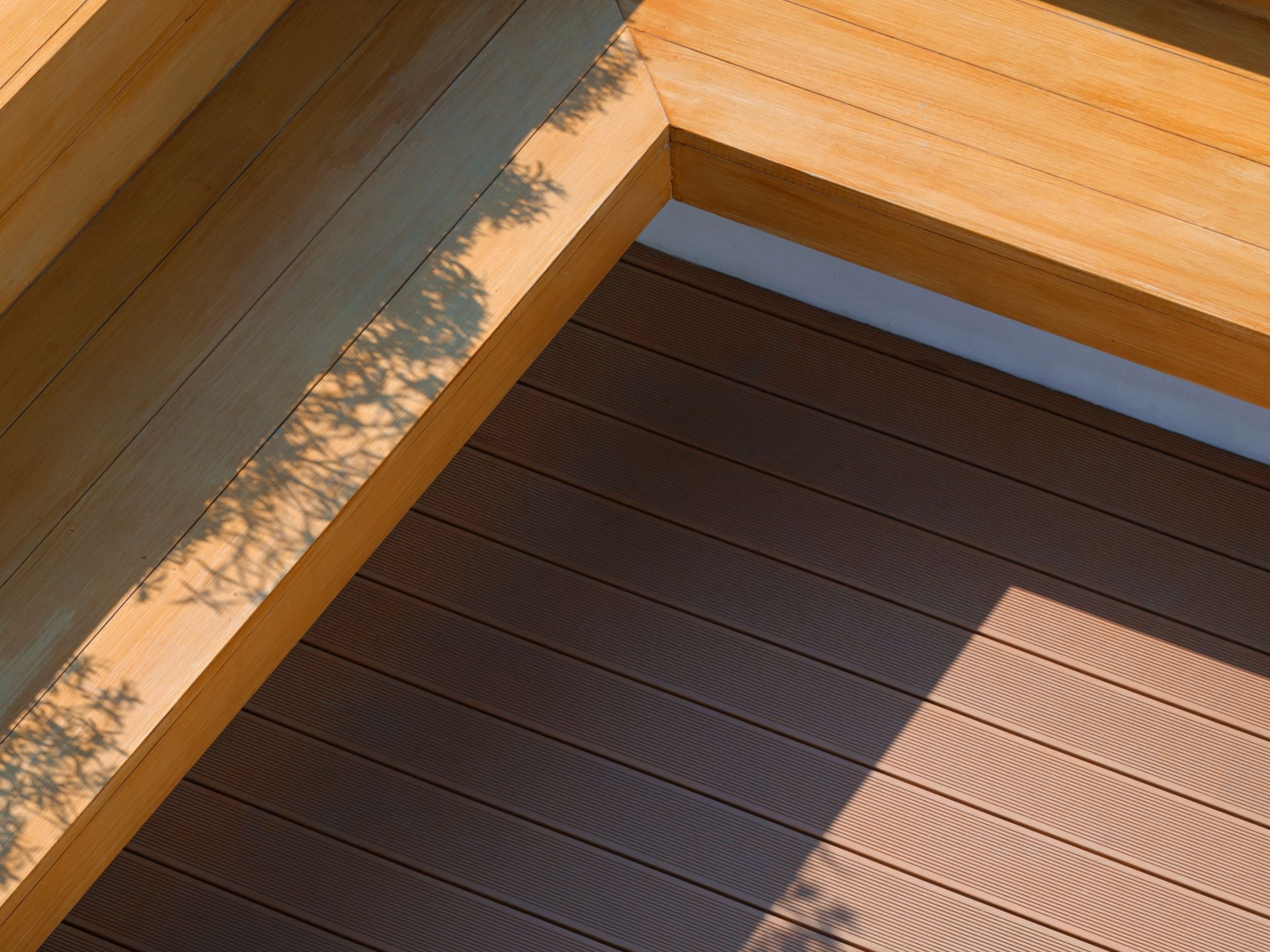
For many homeowners the look is the deciding factor, and this is where TimberTech has built its strongest reputation. Its premium composite and AZEK boards are frequently singled out for the most convincing wood-grain texture and multi-tonal coloring.
Trex is not far behind and offers a deep, well-priced catalog. Its Transcend line in particular delivers rich, streaked tropical-hardwood looks. When you compare samples, grain realism tends to favor TimberTech's premium lines, though the gap narrows at the top of Trex's range. Color selection is broad on both, so the smarter move is to match the deck to your siding and trim rather than to a brand badge. Both brands also sell coordinating railing and fascia, which lets our team deliver a unified, finished look regardless of which you choose.
Warranties and Transferability
Warranty coverage is closely matched, and both brands signal confidence with long terms. The details are worth reading, because coverage scales with the tier and the rules on transferring it to a future buyer are easy to overlook.
Both TimberTech and Trex offer limited residential warranties covering material defects, plus separate fade-and-stain coverage. Here is what to check before you commit:
- Length scales with tier. Entry composite lines commonly carry 25-year coverage, while TimberTech's AZEK PVC can reach up to 50 years.
- Fade and stain are covered separately, typically for a matching term, which protects the color you paid for.
- Transferability is limited. Most of these warranties allow one transfer to a new owner within a set window, a genuine selling point at resale, so confirm the current terms for your chosen line.
Because a manufacturer warranty only holds if the deck is built to spec, professional installation protects your coverage. Our crews follow each brand's installation standards precisely, which is part of why we also carry GAF Master Elite and Owens Corning certifications on the roofing side of our business.
Which Brand Should You Choose?
There is no universal winner, so match the brand to what your deck actually needs. These profiles capture the most common situations we see in Connecticut.
- Choose Trex if budget and easy availability lead your decision and you want a proven capped composite at a competitive price.
- Choose TimberTech composite (EDGE or PRO) if you want the most realistic wood-grain look and are comparing premium boards.
- Choose TimberTech AZEK if your deck sits near a pool, spa, or heavy shade, or if maximum moisture resistance and a cooler surface are your top priorities.
If you are still deciding between board materials rather than brands, our companion guide on
composite vs. PVC decking breaks that down. To see the full range of decks we build, visit our
deck building services page.
Build a Deck That Lasts With Artisan Building and Remodeling
Choosing between TimberTech and Trex is far easier with a contractor who installs both and knows how each performs in the Connecticut climate. Whether you want the value of a Trex deck or the moisture-proof performance of TimberTech AZEK, our team designs and builds it to last.
Call Artisan Building and Remodeling at (860) 759-8617 or
contact us online for a free estimate. We will walk your property, show you samples from both brands, and give you a clear, itemized quote with no pressure.
Frequently Asked Questions
Are TimberTech and Trex the same company?
No. Trex is made by the independent Trex Company, while TimberTech is a brand of The AZEK Company. That is why TimberTech offers both composite and PVC boards, and Trex offers capped composite only. If you specifically want a wood-free PVC deck, TimberTech is the brand that makes one.
Does Trex make a PVC deck board?
No. Trex builds capped composite decking exclusively, meaning every board has a recycled wood-and-plastic core under a protective cap. If you want a fully wood-free PVC board for maximum moisture resistance, you would choose TimberTech's AZEK line, which Trex does not have an equivalent for.
Which is more expensive, TimberTech or Trex?
At the budget end, Trex Enhance and TimberTech EDGE are closely priced. At the premium end, TimberTech usually costs more, especially its AZEK PVC line, which typically sits at the top of the range. Deck size, railing, and site conditions affect the installed total more than the brand alone.
Which brand stays cooler in the sun?
TimberTech AZEK is engineered to stay cooler than standard boards, and Trex answers with its Transcend Lineage line built for the same purpose, so neither brand has a clear lock on this. In practice, choosing a lighter color affects surface temperature more than the brand you pick.
Is the decking warranty transferable if I sell my house?
Usually, within limits. Both brands typically allow one transfer of their limited warranty to a new owner within a set window, which can be a selling point at resale. Because terms change and vary by product line, we confirm the current warranty details for the exact board you choose before installation.
Share this Post
Recent Blog Post